
How Much Does It Cost to Move House in NSW? A Realistic 2026 Breakdown
Get a realistic 2026 breakdown of what it actually costs to move house in NSW - removalists, packing, cleaning, utilities, storage, and the easy-to-miss extras - plus practical tips to keep your total down.
Lisa
4/29/20266 min read


If you’re downsizing or relocating in New South Wales, the sale price isn’t the only number that matters. The act of moving - packing, transport, cleaning, storage, and turning utilities on and off - can quietly add thousands to your budget.
In this post, I’ll break down the typical costs of moving house in NSW (from Sydney metro moves to regional relocations), what makes prices jump, and how to keep the total under control - especially if you’re downsizing and trying to avoid ‘hidden’ fees.
To make this practical, each section includes a realistic price range, what’s usually included, and quick ways to reduce the spend without creating more stress on moving week.
1. Removalist costs (usually the biggest expense)
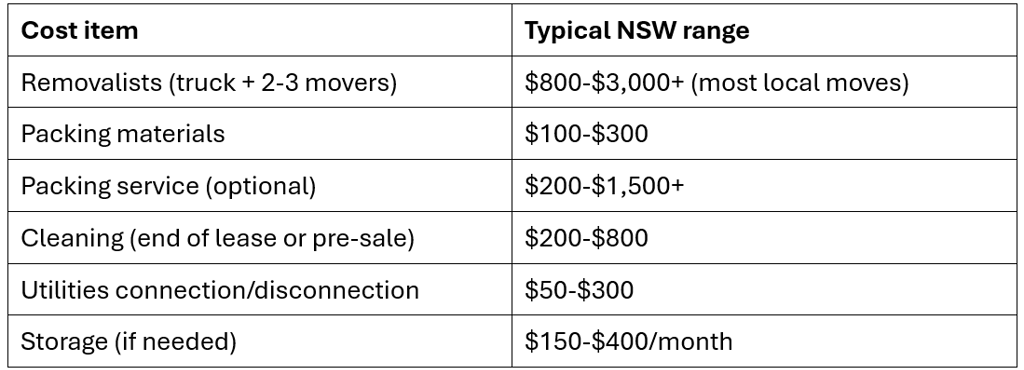
For most people, removalists are the largest line item - because you’re paying for labour, a truck, fuel, and the time it takes to load, drive, and unload. Rates vary by city, day of week, access to the property (stairs, lifts, tight driveways), and how prepared you are when the team arrives.
Typical NSW pricing
Many removalist companies quote an hourly rate for a team (often 2–3 movers plus a truck). You’ll also see fixed-price quotes for larger or longer-distance moves.
Local move: $100-$180 per hour (2–3 movers + truck is common).
Typical total: $800-$3,000 depending on volume, access, and travel time.
High-volume / complex moves: $3,000-$5,000+ if you have multiple bedrooms, challenging access, or a long day of labour.
What pushes the price up
Long-distance relocations (for example, Sydney to the Southern Highlands), weekend moves, narrow stairwells, no parking near the front door, oversized furniture, and delays (waiting for keys, settlement timing, lift bookings, etc.).
How to keep removalist costs down:
Declutter early
Fewer boxes and less furniture reduces hours on the day.
Do a ‘pre-pack’
Have everything boxed, sealed, and labelled before the truck arrives.
Measure access
Tell the company about stairs, lifts, and parking so the quote matches reality.
Avoid peak days
Mid-week and mid-month dates are often cheaper than weekends and end-of-month.
2. Packing materials (DIY packing)
Packing yourself can save money, but you’ll still spend on materials - and underestimating this is common. The basics are boxes in multiple sizes, strong tape, paper or bubble wrap for breakables, and markers/labels.
Boxes: small/medium for books and kitchen items; large for linen and light items.
Protection: butchers’ paper, bubble wrap, and moving blankets for fragile items.
Essentials: heavy-duty tape, a tape gun, markers, and labels.
Estimated cost
$100-$300 for many apartments and smaller homes; more if you have lots of fragile items or prefer premium cartons (wardrobe boxes, picture boxes, porta-robes, etc.).
Where to save
Ask local supermarkets or bottle shops for boxes, check community groups, and reuse tubs/suitcases you already own.
Where not to cut corners
Strong tape and proper wrapping for breakables - replacing damaged items costs more than materials.
If you’re downsizing, packing is also an opportunity to edit your belongings: the less you take, the less you pay to move - and the easier it is to set up the next home.
3. Professional packing services (optional, but sometimes worth it)
Many NSW removalist companies offer packing as an add-on. It’s not essential - but for people working full-time, caring for family, or trying to coordinate sale/settlement dates, it can be the difference between an organised move and a stressful one.
Partial packing: $200-$500 (often used for kitchens, fragile items, or a few rooms).
Full packing: $500-$1,500+ depending on house size, number of cartons, and how much wrapping is required.
Unpacking (sometimes offered): can add more but may help if you need the home functional quickly.
When it’s worth considering
Tight timelines, limited mobility, lots of glassware/artwork, or if you’re downsizing quickly and want professionals to keep things efficient and protected.
4. Cleaning costs (renting, selling, or handing over the old home)
Cleaning is easy to forget until you’re exhausted at the end of moving day. Depending on your situation, you might need an end-of-lease clean (renting), a pre-sale clean to present the property well, or a final ‘handover’ clean so the next owner or tenant receives the home in good condition.
End-of-lease cleaning: often includes bathrooms, kitchen, floors, and sometimes oven/window add-ons.
Pre-sale cleaning: focuses on presentation - skirting boards, windows, bathrooms, kitchens, and floors.
Estimated cost
$200-$600 for many homes, with higher costs if you add carpets, windows, ovens, or have a larger property.
Tip: book cleaners early if you’re moving at the end of the month - these dates fill up quickly in many NSW areas.
5. Utility connection and disconnection (small fees that add up)
Even when providers don’t charge a ‘connection fee’, moving often triggers setup costs, new hardware, or technician visits - especially for internet. The amounts are usually smaller than removalists, but they’re easy to miss when budgeting.
Electricity: transfer/connection fees depending on retailer and meter type.
Gas: reconnection or special meter arrangements in some properties.
Internet: new connection, modem/router, or technician visit if you’re changing address or technology.
Estimated
$50-$300, depending on how many services you’re moving and whether any technician visits are required.
Tip: schedule utilities for the day before you move in where possible - nothing slows a move like no power or no internet when you’re trying to work and unpack.
6. Storage (when settlement dates don’t line up)
Storage becomes relevant when your move isn’t perfectly timed - common during downsizing, renovations, or when you’re waiting for settlement. Even a ‘short’ overlap can become a few weeks, so it’s worth pricing this in advance.
Storage unit: $150–$400 per month (size and location are major drivers).
Potential add-ons: insurance, access fees, locks, or moving the items twice (into storage and out again).
7. Often-overlooked extras (the ‘why did this cost so much?’)
These costs are usually smaller individually, but they can stack up fast - particularly if you’re coordinating work, kids, pets, or a longer drive between locations.
Pet transport or boarding: especially if you need the day clear for movers or inspections.
Moving insurance: some people choose extra cover for high-value items.
Time off work: unpaid leave or lost billable hours can be a real cost.
Travel: fuel, tolls, parking, and accommodation for regional moves.
Access fees: lift bookings, strata requirements, or parking permits in some areas.
So what’s the total cost to move in NSW?
As a rule of thumb, most people in NSW land somewhere between ‘manageable’ and ‘surprisingly expensive’, depending on how much they own and how complicated the move is. Here’s a realistic guide:
Low range (~$1,000): small move, DIY packing, minimal cleaning, no storage.
Typical range ($1,500-$4,000): removalists + materials, plus one or two add-ons like cleaning or utility setup.
Higher end ($5,000+): larger household, long distance, packing service, storage, tricky access, or multiple day labour.
Example mini-budget (typical downsizing move)
Imagine a 2–3 bedroom home moving within the same region, with DIY packing but professional cleaning. You might spend $1,800-$2,600 on removalists, $150-$250 on materials, $300-$500 on cleaning, and $100-$250 on utilities and incidentals. That quickly puts you around $2,350-$3,600 before you add storage or packing help.
Ways to reduce moving costs (without making the move harder)
Declutter before you get quotes
Quotes are based on volume. Donate, sell, or gift items you don’t want to pay to transport (and then store).
Choose an off-peak date
If you can, move mid-week and avoid end-of-month crunch periods.
Get 2–3 quotes (and compare what’s included)
Check minimum hours, call-out fees, travel time, and whether GST is included.
Pack smartly
Label boxes by room and priority, keep screws/remote controls in labelled bags, and set aside an ‘open first’ box for the first night.
Reduce day-of delays
Confirm lift bookings, reserve parking, and organise keys/settlement timing so the crew isn’t waiting on you.
Plan for storage only if needed
Storage can double-handling costs. If you must use it, keep the storage window as short as possible.
Final thoughts
Moving costs in NSW vary widely, but the pattern is consistent: the more stuff you move and the more time the move takes, the more expensive it becomes. That’s why downsizing early - before you book the truck - often produces the biggest savings.
If you’re planning a move, start by listing your likely costs (removalists, materials, cleaning, utilities, and any storage gap). Then build in a buffer for the ‘extras’ that always show up - tolls, parking, and last-minute supplies. A little planning upfront can save you money and a lot of stress on the day.
Quick tip: create a simple downsizing checklist with three columns - keep, sell/donate, and dispose. Every item you move should earn its place in the new home.
Contact
Let's chat about your next chapter.
lisa@downsizingnsw.com
© 2026. All rights reserved.